



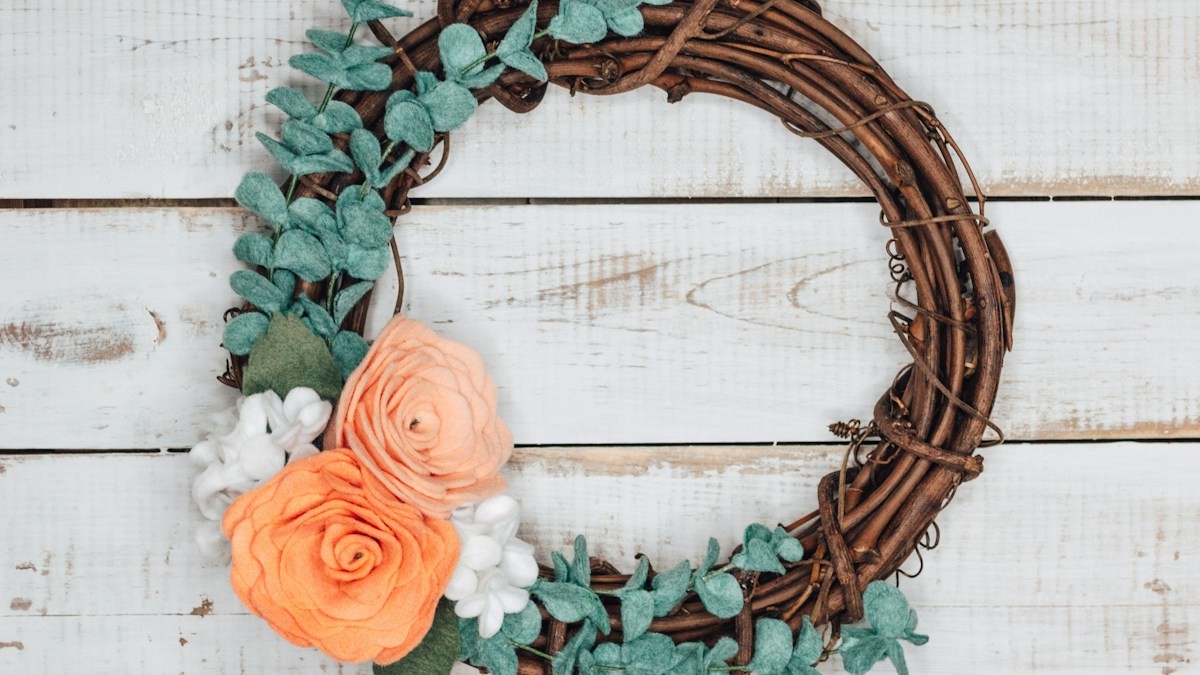
Among all wreath foundations, natural wild grapevine forms (*Vitis vinifera*) possess an unmatched organic elegance. With their dark, twisted woody tendrils, rustic branch textures, and earthy woodland presence, grapevine wreaths provide the quintessential base for farmhouse, seasonal, and holiday front door displays. Unlike artificial foam rings or bare wire forms, a grapevine base is inherently beautiful in its own right, functioning not merely as a structural armature to be hidden, but as an integral aesthetic element of the finished design.
However, designing on natural grapevine presents unique physical challenges. The natural woody vines are irregular, porous, and prone to shifting. Attaching heavy decorative elements—such as voluminous wired bows, heavy ceramic signs, and dense seasonal floral picks—without proper mechanical anchoring often results in drooping components, unsightly exposed zip-ties, and wreaths that hang lopsidedly against the door.
This comprehensive floral crafting manual guides you step-by-step through designing a professional wire frame grapevine wreath. You will master base selection and wire reinforcement, learn the art of fluid ribbon meandering through woody crevices, master asymmetrical golden-ratio focal placement, and secure botanicals with commercial-grade adhesive and wire techniques.
Grapevine Base Selection, Pruning, and Structural Wire Reinforcement
Preparing natural woody armatures for heavy decorative loads.
Evaluating Quality in Natural Grapevine Forms
When purchasing a natural grapevine wreath (a standard 18-inch outer diameter is ideal for standard 36-inch front entry doors), inspect the density of the vine weave. High-quality bases are tightly wound with substantial depth (3 to 4 inches thick), offering a firm internal root core that holds floral stems securely.
Avoid loosely wrapped wreaths that feel squishy or springy, as they lack the density required to anchor heavy elements. Use heavy bypass hand pruners to cleanly snip away any wild, unruly branches protruding awkwardly from the front, while preserving the natural textured silhouette.
The Internal Wire Reinforcement and Hanging Loop
Before adding any decorations, reinforce the structural integrity of the base. Thread a length of 18-gauge green floral wire entirely through the back half of the wreath at the top, wrapping it securely around the inner vine core.
Twist the wire ends into a sturdy, rigid 2-inch hanging loop that remains concealed behind the top branches. Establishing this heavy-duty hanging anchor first ensures that your wreath hangs perfectly plumb and flush against your door hanger.
Ribbon Weaving Dynamics: The Meandering Vine Cascade
Integrating luxurious textiles into woody crevices without flattening loops.
The Meandering Branch Weave Technique
Rather than wrapping ribbon tightly around a grapevine wreath like a candy cane—which smothers the organic beauty of the wood—designers utilize the ‘meandering weave.’ Anchor the end of a 2.5-inch wired burlap or canvas ribbon to the back with floral wire.
Guide the ribbon loosely across the face of the wreath, allowing it to dive into deep crevices between twisted vines and re-emerge several inches away. Catch the wire edge behind protruding vine tendrils, letting the fabric billow outward in soft, dimensional clouds that showcase both the textile and the natural wood.
Pairing Contrasting Ribbon Streamers
Beneath your primary meandering ribbon, introduce a secondary 1.5-inch accent ribbon in a contrasting texture (such as a rich plaid or shimmering metallic linen). Allow the tails of both ribbons to cascade downward from the focal point.
Cut the streamers with crisp 45-degree dovetails at staggered lengths, allowing them to flutter gracefully in ambient breezes.

Asymmetrical Focal Architecture and Botanical Anchoring
Applying the Golden Ratio for dynamic, museum-grade floral compositions.
The Golden Ratio: The 8 O’Clock Crescent Layout
Symmetrical wreaths—where decorations are distributed identically around the entire circle—often appear static and dated. Master florists employ the Golden Ratio (a 60/40 visual weight distribution) by concentrating decorations in an asymmetrical crescent along the bottom-left quadrant (centered around the 7 to 8 o’clock position).
Position a magnificent multi-loop wired bow at the 8 o’clock focal point. Radiate floral picks outward in an elegant crescent curve tapering toward 11 o’clock and 5 o’clock, leaving the remaining 40% of the upper-right grapevine proudly bare to showcase its raw woodland texture.
The Hot Glue Skillet and Floral Stem Anchoring
Individual hot glue gun drops cool too quickly when applied to porous grapevine. Professional wreath makers utilize an electric hot glue skillet (or an electric frying pan melted with high-temperature glue pellets) maintained at 350°F.
Trim your artificial floral and berry pick stems to approximately 3 inches with heavy wire cutters. Dip the bottom 2 inches of the wire stem directly into the molten glue skillet, immediately push the stem deep into the dense inner grapevine core, and hold for 10 seconds. The molten glue penetrates deep into the porous vine fibers, creating an unbreakable mechanical and chemical bond.
Grapevine Wreath Design Styles & Element Balance
| Wreath Style | Grapevine Exposure | Bow Placement | Floral Pick Coverage | Design Philosophy |
|---|---|---|---|---|
| Asymmetrical Crescent | 40% – 50% Bare Vines | 8 o’clock focal point | Crescent curve along left | Modern Designer Standard |
| Half-Wreath Sweep | 50% Bare Vines | Bottom center (6 o’clock) | Dense lower half semicircle | Traditional Farmhouse |
| Full Coverage Floral | 10% Bare Vines | Top center or bottom | 360-degree dense perimeter | Victorian Opulence |
| Minimalist Botanical | 75% Bare Vines | Tailored Dior bow on side | 3-5 delicate eucalyptus stems | Scandinavian Modern |
Recommended Further Reading & Authoritative References
To deepen your practical mastery of these concepts, explore our comprehensive analyses on handcrafting voluminous 8-loop wired ribbon centerpiece bows and comparing natural grapevine bases with elevated steel deco mesh frames. For official technical standards, peer-reviewed benchmarks, and industry guidelines, consult the Southern Living Guide: Crafting Beautiful Grapevine Wreaths.
Advanced Implementation Strategies and Field Best Practices for Wire Frame Grapevine Wreath
When implementing these methods in real-world scenarios, consistency and continuous observation serve as the primary determinants of long-term success. Experienced practitioners recognize that theoretical frameworks must be adjusted to account for subtle environmental variables, microclimate fluctuations, and individual behavioral variations. Establishing a disciplined monitoring log allows you to identify subtle trend shifts early, long before minor discrepancies escalate into systemic issues.
Furthermore, avoiding common beginner pitfalls requires a firm adherence to validated core principles rather than adopting transient shortcuts or unverified commercial gimmicks. Integrating periodic structural audits—whether assessing substrate integrity, water chemistry equilibrium, physical mechanical wear, or nutritional bioavailability—guarantees that every safeguard remains fully operational. By prioritizing holistic wellbeing and systematic execution, you establish an environment of enduring stability, resilience, and superior measurable outcomes.
Frequently Asked Questions
How do I clean a dusty grapevine wreath from last season?
Take the wreath outside and use a hair dryer on the cool, high setting to blow away accumulated dust. For stubborn cobwebs, use a soft-bristled paintbrush to gently sweep between the branches.
Will a natural grapevine wreath attract bugs or spiders to my front door?
Commercial grapevine wreaths sold in craft stores are heat-treated and kiln-dried to eliminate wild insect pests. However, if using wild harvested vines, bake them in an oven at 200°F (95°C) for 1 hour to kill any dormant pests.
Can I reuse a grapevine wreath form for different seasons?
Yes! If you anchor your bows and seasonal florals with green pipe cleaners or floral wire instead of hot glue, you can effortlessly detach autumn leaves and swap in holiday pine boughs in December.
What is the best way to keep a grapevine wreath from scratching my front door?
Stick small self-adhesive felt furniture pads onto the back of the thickest protruding grapevine branches. The soft felt glides smoothly against door paint without scratching.